
Cloud Hosting And Managed IT Services: Key Concepts, Components, And Use Cases

Infrastructure components and resource models for cloud hosting and managed IT services
Core infrastructure components typically include compute instances, container runtimes, block and object storage, virtual networking, and identity and access controls. Compute can range from provisioned virtual machines to serverless functions and containers; each model may affect operational visibility and cost characteristics. Storage choices often balance performance, durability, and access patterns—for example, high-throughput block storage for databases versus object storage for archival data. Identity controls and network segmentation are central to isolating workloads and managing permissions between managed teams and internal users.
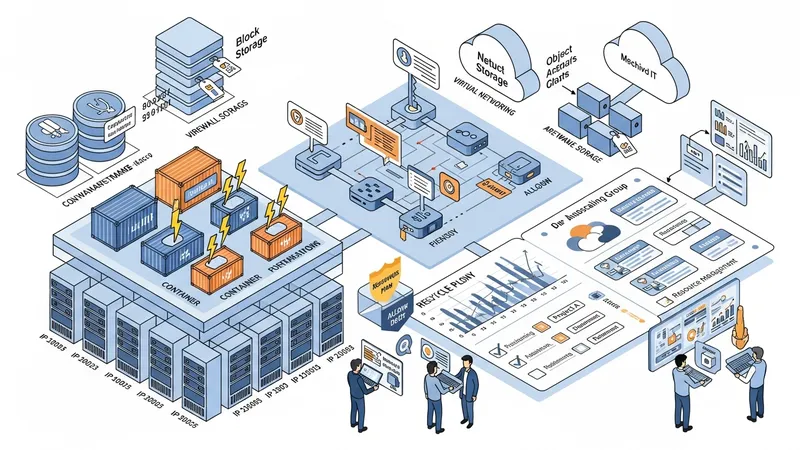
Resource allocation models commonly used are reserved or on-demand provisioning and autoscaling groups that adjust capacity to demand. Autoscaling may reduce manual intervention but typically requires reliable metrics and health checks to avoid unintended scaling. Reservations or savings plans can be used where predictable workloads exist to control baseline costs. Managed teams often establish policies for provisioning and lifecycle management to enforce tagging, cost allocation, and retirement procedures so resources do not remain unmanaged.
Integration of platform tools such as container orchestrators often changes the operational footprint. Orchestration introduces control planes and stateful storage considerations that must be addressed by both platform engineers and managed operators. For stateful workloads, managed services typically include procedures for backup, snapshot lifecycle, and restoration validation. Stateless application components can often be redeployed more easily, but they still require monitoring and configuration management to maintain consistency across deployments.
When designing infrastructure for combined cloud hosting and managed services, teams often consider service-level objectives and recovery expectations alongside technical constraints. Defining measurable metrics—availability percentages, mean time to recovery ranges, and backup frequency—helps align managed tasks with business needs. Such definitions may be revisited periodically as application usage patterns evolve or when dependencies change, supporting more effective coordination between infrastructure components and managed operational responsibilities.