
Cloud Billing Management: Key Features, Modules, And Workflow Overview

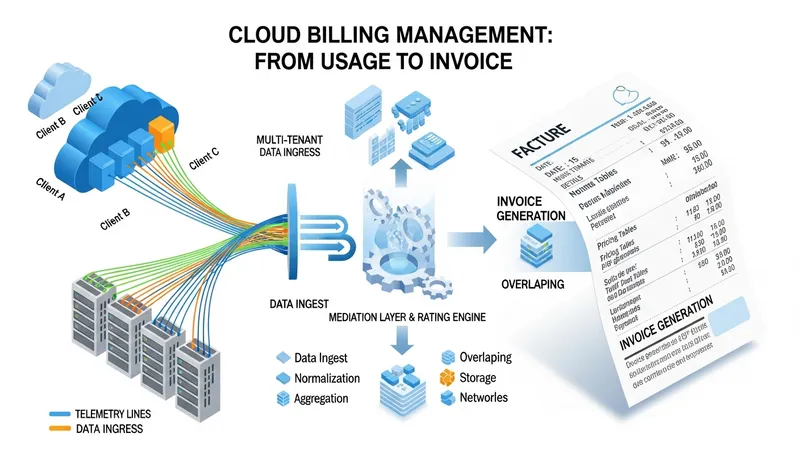
Cloud billing management is the coordinated set of systems and processes that measure cloud resource consumption, convert usage into monetary units, apply pricing and tax rules, and produce invoices and reports. In practice, this concept covers metering of compute, storage and network resources; rating engines that map usage to pricing plans; mediation layers that normalize raw telemetry; and invoice generation that reflects taxation and regulatory requirements. For organisations operating in France, additional elements often include VAT (TVA) handling, French-language invoice presentation, and data-processing considerations under national and EU law.
Key modules in a cloud billing architecture typically include usage collection, rating and pricing engines, account balance management, invoice formatting and distribution, dispute handling, and analytics. These modules may integrate with accounting systems (logiciels de comptabilité), customer portals, and identity systems. In the French context, billing systems may need to support formats and content required by local authorities and comply with CNIL guidance for personal data processing when customer identifiers or usage traces are involved.
- OVHcloud billing — French public cloud provider offering metered instances and consolidated invoicing; typical compute-hour billing may vary and can be observed on provider price pages (example ranges often start from fractions of a euro per hour for small instances).
- Scaleway billing — French cloud platform with per-resource metering and API access to consumption records; storage and object pricing often quoted per GB-month and network egress per GB on provider pages.
- Outscale billing — Outscale (a French cloud service) provides enterprise-oriented billing features and contractual invoicing adapted to French corporate customers; pricing models may include usage-based and reserved options.
Comparing these example providers illustrates common billing elements: machine-hours or vCPU-hours, GB-month storage units, and GB network transfer units. A billing solution may aggregate these units into a single invoice and apply discounts, committed-use rates, or tiered pricing structures. In France, invoices typically must show VAT at the applicable rate and contain specific legal mentions; service-public.fr and related guidance outline mandatory invoice components that billing modules often produce automatically. These requirements influence invoice templates and calculation flows.
Rating engines and pricing models are central to translating metered usage into charges. Common approaches include pay-as-you-go metering, tiered volume pricing, and subscription or recurring charges for managed services. For multi-tenant environments, billing systems often include tenant-specific tariff tables and allocation rules so that consumption is billed to the correct legal entity. When operating in France, organisations often consider how TVA applies to cross-border services and whether domestic or intra-community rules affect invoice presentation.
Data collection and mediation layers typically handle raw telemetry from hypervisors, object stores, and network devices, converting diverse records into normalized usage records. Normalization may include time-based aggregation, rounding rules, and attribution to cost centers. In France, where data residency and protection are considerations for some sectors, architects may choose France-based storage or regional availability zones to align with organisational policies and CNIL recommendations. These choices can affect latency of reporting and storage costs that appear in billing.
Integrations with accounting and ERP systems are common in an operational billing workflow. Systems such as French bookkeeping software and ERP connectors may import invoice data, taxes, and journal entries exported by the billing platform. Reconciliation modules often compare expected revenue from rated usage to payments received, flagging discrepancies for investigation. For organisations subject to audit in France, maintaining a clear audit trail of rated usage, invoice versions, and tax calculations can support compliance checks.
Scaling a billing platform involves both technical and organisational considerations: the ability to process increasing volumes of usage records, to maintain low-latency rating for real-time billing scenarios, and to support high concurrency for customer portals. In France, seasonal demand patterns in certain industries (retail, media) may require capacity planning and testing to avoid billing delays. Monitoring and capacity planning tools may often be used to project processing needs and to schedule maintenance without affecting invoicing cycles.
In summary, cloud billing management covers metering, rating, invoicing, reporting, and integrations adapted to local regulatory and tax requirements. In the French context, VAT handling, invoice content, and data-protection considerations commonly influence system design and operational procedures. The next sections examine practical components and considerations in more detail.