
CAASM: Understanding Cyber Asset Attack Surface Management Fundamentals

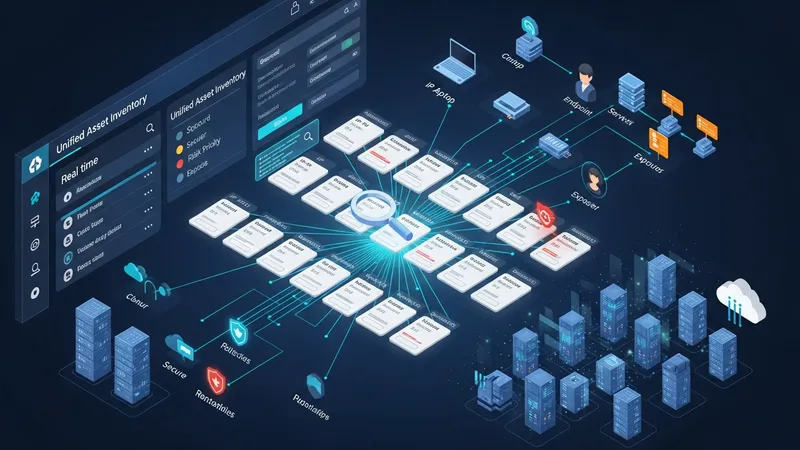
Cyber Asset Attack Surface Management (CAASM) is a systematic approach to maintaining an organized view of an organization’s digital assets and their exposure to potential threats. It centers on consolidating disparate sources of asset information—cloud inventories, endpoints, network devices, identities, and software instances—into a unified inventory. CAASM systems aim to make asset attributes, relationships, and contextual metadata discoverable so that security teams can assess configuration drift, dependencies, and external exposure across hybrid and multi-environment deployments without presuming any single deployment model.
In practice, CAASM complements other security functions such as vulnerability management, identity governance, and security monitoring by providing a consistent asset model and authoritative inventory. It typically focuses on continuous discovery, normalization of asset data, mapping identities to resources, and enabling queryable visibility for analysis. CAASM outputs may feed into risk prioritization workflows, reporting, and security orchestration tools, while remaining an operational layer that updates as environments change.
- Agent-based discovery: software agents installed on hosts that collect local configuration and installed software metadata to populate an asset inventory.
- Cloud inventory and API aggregation: collection of resource and configuration data from public cloud provider APIs and management consoles for cloud-native assets and service configurations.
- Passive network and endpoint scanning: network-aware methods that observe traffic, DNS, and endpoint broadcasts to infer devices and services without installing agents on every system.
Different discovery approaches may suit different environments and risk profiles. Agent-based discovery can provide detailed, host-level telemetry including installed software and local configuration, which may often improve fidelity for on-premises hosts. Cloud API aggregation typically exposes resource metadata and IAM configurations that are relevant to cloud exposures. Passive network discovery can be useful in segmented networks or for transient devices where installing agents is impractical. Each method may produce overlapping and inconsistent records that require reconciliation and careful handling of stale or duplicate entries.
Data normalization and asset-model design are central operational challenges. Asset sources commonly use varying identifiers and attributes; reconciling hostnames, IPs, instance IDs, or service names often requires deterministic or probabilistic correlation rules. Asset records can include relationships—such as host-to-application mapping or identity-to-resource associations—that may be represented as graphs to improve queryability. Maintaining timestamping, provenance metadata, and confidence scores for each attribute can help downstream consumers understand when entries were last validated and how reliable each source may be.
Integration with vulnerability, configuration, and identity datasets is where CAASM typically provides practical value. By linking asset records to vulnerability scanner outputs, configuration baselines, and identity management data, teams can contextualize exposures. For example, an internet-facing service identified through passive discovery may be associated with a cloud instance and a set of IAM roles, which could then be examined alongside known vulnerabilities or misconfigurations. These cross-references often inform prioritization but should be used as contextual inputs rather than definitive risk judgments.
Operationalizing CAASM requires attention to governance, role definitions, and lifecycle processes that often vary by organization size. Establishing data ownership for asset records, defining acceptable synchronization frequencies, and setting rules for decommissioning or archival of assets can reduce inventory drift. CAASM outputs may feed dashboards, tickets, or automated playbooks, yet organizations typically find value in human review loops for ambiguous correlations. Measuring coverage, asset classification accuracy, and time-to-detection for new assets can serve as practical metrics for continuous improvement.
In summary, CAASM is a systems-level practice that seeks to consolidate asset visibility, map relationships, and support informed security decision-making through continuous discovery and normalization. It typically complements existing security tools by offering an authoritative inventory layer that other functions may consume. The next sections examine practical components and considerations in more detail.