
BMC Remedy: Introduction To IT Service Management Capabilities

An enterprise IT service management platform organizes IT operations by grouping capabilities into modules for incident tracking, problem analysis, change coordination, asset tracking, and service request fulfilment. Such a platform typically centralizes data in a configuration management database (CMDB), supports defined workflows to route tasks and approvals, and provides a single interface for service agents and end users. The conceptual goal is to provide a cohesive set of functions that can be configured to reflect organizational processes, roles, and operating procedures while enabling visibility across incidents, changes, assets, and requests.
Key capabilities often include workflow engines to automate routine steps, a service desk interface for handling tickets, reporting and dashboards for operational metrics, and knowledge base tools to capture institutional information. The platform may integrate with monitoring systems, identity sources, and external tools using APIs or connectors. Implementation typically involves mapping existing processes to platform modules, defining SLAs and escalation rules, and configuring forms and notifications to match organizational needs rather than replacing governance or process design.
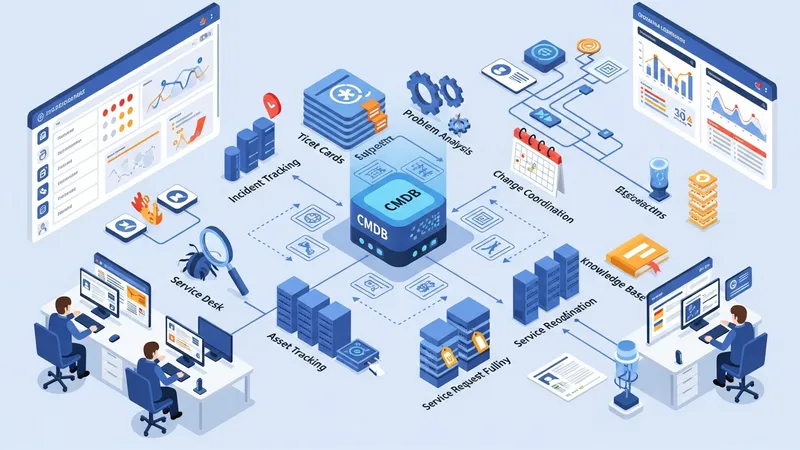
- Incident management module — records and tracks service interruptions and restoration steps, typically including categorization, priority, and SLA fields.
- Change and release management module — coordinates approvals, scheduling, and risk assessment for infrastructure or application changes.
- Asset and configuration management (CMDB) — stores hardware, software, and relationship data used to assess impact and maintain inventories.
- Service request and fulfillment tools — provide templated request forms, approval routing, and fulfilment workflows for standard services.
- Knowledge management and self-service portal — captures resolutions and enables users to search articles, often reducing repeat tickets.
Integration and workflow automation are commonly used to reduce manual handoffs and improve consistency. Automated workflows may create tasks, send notifications, enforce approval gates, and update related records across modules; they can often be extended through scripting or integration adapters. When automation is applied, organizations typically plan for exception handling and regular review of automated rules to prevent drift between documented processes and actual operations. Metrics such as mean time to resolution (MTTR) and change success rates are often used to evaluate the effect of workflow automation.
Service desk and self-service features can alter how users interact with IT. A unified service interface may combine incident intake, request submission, and knowledge search. Self-service portals often allow users to raise standard requests via guided forms and track progress, while agents use the service desk view to manage queues and escalations. It is common for organizations to pilot a subset of request types to refine forms and approvals before broad rollout, which may reduce rework and clarify ownership of recurring tasks.
Knowledge management and reporting functions support operational learning and transparency. Knowledge bases typically store solutions, troubleshooting steps, and configuration notes that agents or end users can search; maintenance of these entries is often governed by review cycles to keep content current. Reporting and dashboards can combine data from incidents, changes, and assets to provide cross-functional insights. Organizations often configure recurring reports for capacity planning, SLA compliance, and trend analysis to inform resource allocation and process adjustments.
Asset and configuration management interacts with change control to provide context for risk and impact analysis. A CMDB that captures relationships between services and underlying components may be used to identify downstream effects of proposed changes or incidents. Populating and reconciling asset data often requires discovery tools and periodic audits; many teams adopt phased approaches to populate critical service relations first. When change processes reference CMDB data, reviewers can better estimate affected users and systems, which may improve planning and reduce unintended disruptions.
In summary, an enterprise ITSM platform collects modular capabilities—incident, change, asset, request, knowledge, automation, and reporting—into a single operational environment that may support standardized workflows and consolidated data. Implementation strategies typically emphasize phased configuration, integration with existing monitoring and identity systems, and governance for knowledge and CMDB accuracy. The next sections examine practical components and considerations in more detail.