
Biomass Gasification Systems: How Thermochemical Conversion Produces Syngas For Energy

Biomass gasification systems are engineered processes that convert solid organic materials into a combustible gas mixture through controlled thermochemical reactions. In these systems, biomass undergoes drying, pyrolysis, partial oxidation, and reduction under elevated temperatures to produce synthesis gas (syngas), which typically contains hydrogen (H2), carbon monoxide (CO), carbon dioxide (CO2), methane (CH4), and light hydrocarbons. The conversion path depends on reactor design, heating rate, and the presence of oxidants such as air, oxygen, or steam. Gasifiers are sized and configured to balance thermal inputs, reaction residence times, and desired syngas composition for downstream use.
Key operational variables include temperature profiles, equivalence ratio (the fraction of oxidant relative to complete combustion), and feedstock characteristics such as moisture and particle size. Different reactor types—fixed-bed, fluidized-bed, and entrained-flow—promote distinct reaction regimes and syngas properties. Gas cleaning and conditioning stages follow conversion to remove tars, particulates, and alkali species when syngas is intended for engines, turbines, or synthesis processes. System integration often considers heat recovery and gas utilization pathways to improve overall energy efficiency.
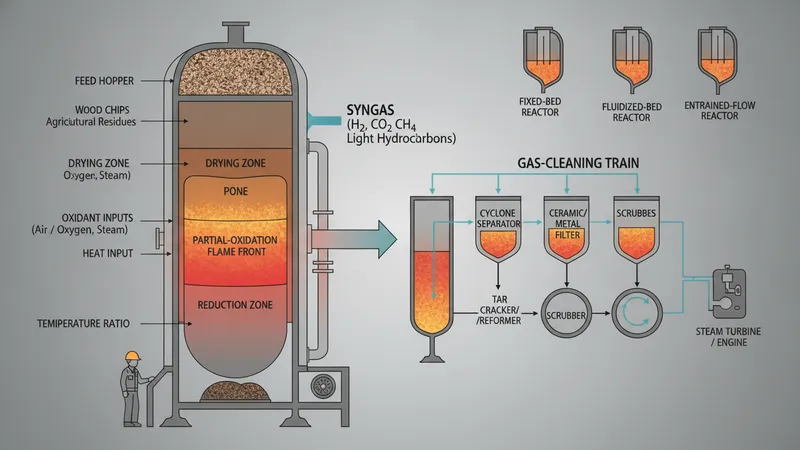
- Fixed-bed gasifiers (updraft, downdraft): Typically handle coarse biomass with relatively low throughput; may produce variable tar concentrations depending on configuration.
- Fluidized-bed gasifiers (bubbling, circulating): Often allow better mixing and temperature control for moderate feedstock moisture and heterogeneous particles.
- Entrained-flow gasifiers: Use finely ground or pulverized feedstock at higher temperatures and may yield syngas with lower tar but require feed preparation.
Comparative reactor performance often hinges on trade-offs between feed flexibility and syngas cleanliness. Fixed-bed designs can tolerate larger particle sizes and simpler feeding systems but may produce higher tar yields that complicate downstream use. Fluidized beds generally provide more uniform temperature distribution and can support staged gasification for improved conversion, though they can be sensitive to ash characteristics and bed agglomeration. Entrained-flow reactors operate at higher temperature and pressure ranges that may suppress tar formation but typically demand more intensive feed preprocessing and auxiliary energy input.
Feedstock preparation is a central determinant of process stability and syngas quality. Moisture content, particle size, and inherent ash composition influence drying energy, heat transfer, and slagging or fouling tendencies. Typical target moisture levels for many gasifiers may range from about 10–20% on a wet basis, though specific systems can accept higher or lower values depending on thermal design. Pretreatment options such as drying, torrefaction, or pelletizing can improve fuel homogeneity but introduce additional processing steps and energy considerations that affect overall system efficiency.
Energy efficiency in gasification systems can be evaluated through cold gas efficiency and overall system energy balance, taking into account heat recovery and power generation choices. Cold gas efficiency—ratio of chemical energy in produced syngas to energy in the dry feedstock—may vary widely with reactor type and operating conditions and often falls below unity when parasitic loads and gas cleaning are included. Integration strategies such as combined heat and power (CHP) or catalytic upgrading can influence how much primary energy is practically recovered from the biomass source.
Environmental considerations encompass emissions, lifecycle greenhouse gas implications, and residues management. Gasification can reduce direct particulate and volatile emissions compared with open burning of biomass when properly controlled, but attention to tar decomposition and trace contaminants is important. Ash and char byproducts may contain concentrated minerals and heavy metals depending on feedstock, which affects disposal or recycling options. Lifecycle assessments often emphasize feedstock sourcing and land-use impacts as key variables when estimating net carbon flows associated with gasification-based energy.
In summary, these systems convert solid biomass into a versatile synthesis gas through staged thermochemical reactions that are sensitive to feedstock, reactor design, and operating conditions. Practical implementation typically balances feed preparation, reactor selection, syngas cleaning, and energy integration to meet targeted end uses such as heat, power, or chemical synthesis. The next sections examine practical components and considerations in more detail.