
Battery Energy Storage Systems: Key Considerations For Business Adoption And Planning

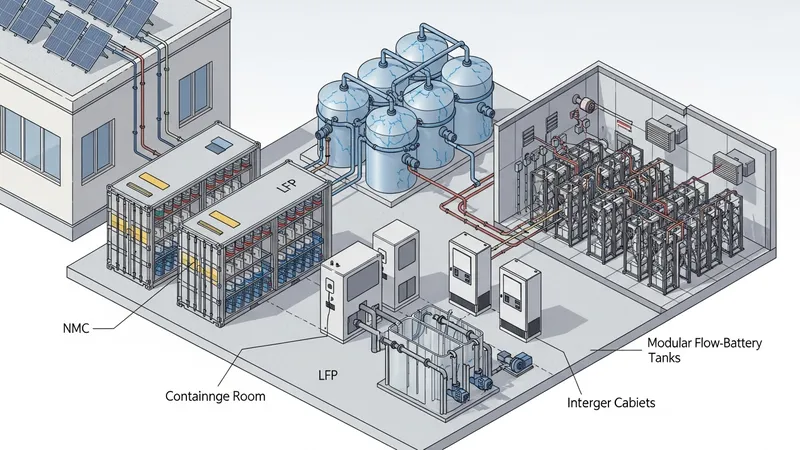
Types and configurations relevant to Battery Energy Storage Systems: Key Considerations for Business Adoption and Planning
Understanding available types and configurations helps frame technical trade-offs. Lithium‑ion chemistries (e.g., NMC, LFP) are common in U.S. commercial projects due to established supply chains and high round‑trip efficiency, while flow batteries and other chemistries may be considered for multi‑hour duration. Systems can be packaged as containerized units for rapid deployment or as custom-built installations integrated into existing structures. Businesses may compare modularity, scalability, and redundancy options when mapping a system to site needs.
Electrical configuration choices affect performance and integration. Power capacity (kW) and energy capacity (kWh) are typically sized separately; owners may request a specified discharge duration at rated power. The choice of inverter topology, whether AC‑coupled or DC‑coupled, can influence how the system interfaces with solar PV or existing facility loads. Controls that support ride-through and frequency response may be required for market participation in some ISOs/RTOs such as PJM or CAISO.
Thermal management and safety design are configuration-level considerations that can influence operations and site planning. Enclosures with active cooling or passive ventilation, fire suppression systems compliant with local and national fire codes, and battery management systems with cell‑level monitoring are often evaluated. Compliance with standards such as those from the National Fire Protection Association (NFPA) and guidance from the National Electrical Code (NEC) may shape installation approaches in the U.S.
When businesses compare configurations, procurement and supply-chain factors are part of the decision context. Lead times for containers, inverter supply, and certain battery cell chemistries can fluctuate, and site-specific civil or electrical work may be necessary. Organizations often factor in contingency time and coordination with local utilities during planning to align installation schedules and interconnection milestones.