
Automatic Pallet Wrapping Machine: How Automated Stretch Wrapping Systems Work

Automatic pallet wrapping machines are industrial systems that apply stretch film to palletized loads to stabilize and protect goods during storage and transport. These systems automate the film application step that otherwise would be done manually, using mechanical motion and controlled film carriage to wrap film around a pallet. Common components include a film carriage, a mechanism to rotate either the pallet or the film head, tension and prestretch devices for the film, and sensors or controls that determine wrap patterns and counts. In Mexican distribution and manufacturing contexts, these machines may be configured to match local pallet dimensions and throughput patterns.
The operational goal of an automated stretch wrapping system is to deliver consistent wrap coverage while limiting film use and handling time. Systems may operate around a rotating turntable that moves the load, or by moving a rotating arm or ring around a stationary pallet. Control systems often allow settings for wrap height, number of top and bottom wraps, and film tension. Installations in Mexico may be integrated with conveyor lines or used as stand-alone units in maquiladora facilities, logistics centers, and cold-storage warehouses where repeatable load stability is needed.
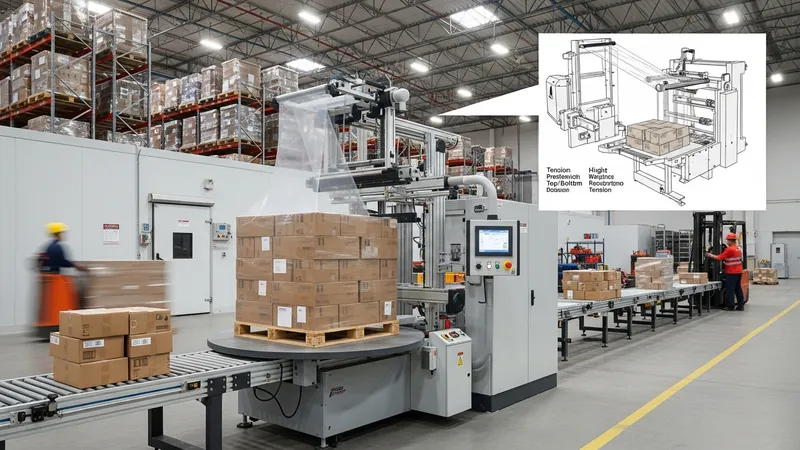
- Rotating turntable systems — machines that spin the pallet while a stationary film carriage applies film; commonly used for medium-throughput facilities.
- Rotary arm or ring wrappers — units that keep pallets stationary while a rotating arm applies film around the load; often selected where large or irregular loads are handled.
- Automatic film pre-stretch and carriage systems — mechanisms that apply controlled prestretch to film to reduce consumption and improve containment force during transport.
Rotating turntable machines typically place film via a carriage that moves vertically while the pallet turns. Turntables may be floor-mounted or integrated into conveyor lines in Mexican plants in Monterrey or Querétaro, where space and line speed influence selection. Turntable systems often have simpler mechanical layouts and can be paired with basic safety cages or light curtains. For loads that fit standard pallet sizes and where throughput is moderate, turntables may offer predictable wrapping cycles. Operators often program wrap height and cycle counts through a local control interface, and maintenance tends to focus on drive belts, bearings, and the film carriage motor.
Rotary arm and rotary ring wrappers often address taller or unstable loads by keeping the pallet stationary and moving the film around the load. This approach can reduce lateral forces on stacked goods and may be used in Mexican distribution centers handling fragile or top-heavy items. Rotary arms can be configured with variable speed and torque settings so wrap patterns are adjusted for different product types. Because the pallet does not move, conveyor alignment and pallet positioning must be precise; this is commonly managed by upstream guide rails or automated pallet stops in facilities in Guadalajara or Puebla.
Film prestretch systems are a key component for reducing film consumption and increasing containment force per meter of film used. In Mexico, prestretch ratios may typically range from 150% to 300% depending on film type and carriage design, although exact settings vary with load characteristics. Carriage designs that use mechanical prestretch rollers or powered prestretch motors enable more consistent film elongation than manual methods. Facilities often balance prestretch settings against film breakage risk, since higher prestretch may reduce film thickness requirements but can increase sensitivity to defects in the film roll.
Control and automation features vary from simple timers and wrap-count selectors to programmable logic controllers (PLCs) with HMI panels and optional network interfaces. In Mexican warehouses seeking data integration, PLC-based wrappers may communicate wrap cycle counts, fault codes, and basic production metrics to a plant automation system. Safety interlocks, emergency stops, and light curtains are commonly integrated with control logic to meet workplace safety practices promoted by Mexican authorities. Service access and local technician training are operational considerations, since downtime can affect outbound shipments in regional hubs like Tijuana.
Operational considerations for layout, film selection, maintenance, and energy use often influence the total cost of ownership in Mexico. Film type (linear low-density polyethylene, pre-stretched films) and roll sizes influence changeover frequency and storage needs. Maintenance cycles commonly include tensioner inspection, motor lubrication, and sensor calibration. When evaluating automated wrappers for Mexican facilities, planners may factor in local service availability, spare-parts lead times, and compatibility with existing conveyor modules. The next sections examine practical components and considerations in more detail.