
App Development: Lifecycle, Methodologies, And Common Tools

App development as a topic covers the sequence of stages, common organizational methods, and the software tools that teams use to produce mobile and web applications. The lifecycle typically describes phases such as requirements gathering, design, implementation, testing, deployment, and ongoing maintenance. Methodologies address how work is organized and iterated — for example, approaches that emphasize fixed phases versus iterative cycles. Common tools include version control systems, issue trackers, interface design applications, build automation, and runtime frameworks that support development and delivery. Discussing these elements together helps clarify how projects move from concept to a maintained product.
Within the lifecycle, interactions among phases are often bi-directional: testing may reveal design changes, and operations feedback can influence requirements. Methodologies define the cadence of those interactions — teams using iterative approaches may plan in short cycles and reassess priorities frequently, while teams using sequential approaches may complete full design specifications before development. Tooling supports both coordination and technical execution: code repositories preserve history, task boards track progress, design tools prototype interfaces, and CI/CD systems can automate builds and tests. These components together shape how predictable, traceable, and repeatable a project can be.
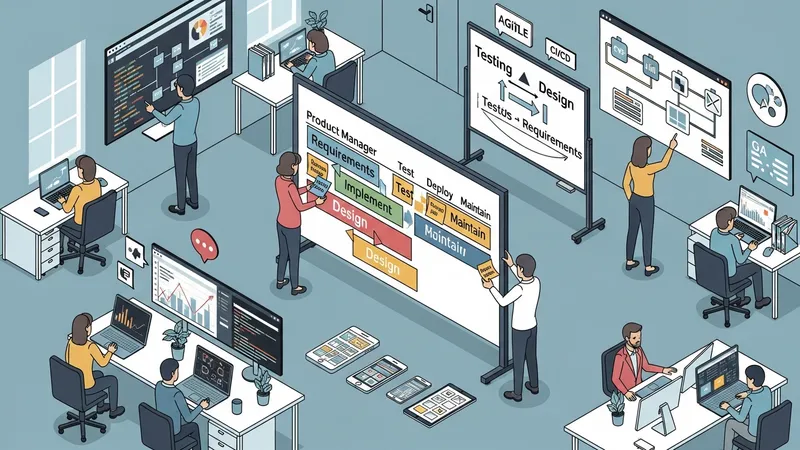
- Agile methodologies (examples: Scrum, Kanban) — describe iterative planning, sprints or continuous flow, and roles such as product owner or scrum master that may structure team workflow.
- DevOps and CI/CD practices — describe continuous integration, automated testing, and automated delivery pipelines that may shorten feedback loops between development and operations.
- Common tooling (examples: Git, Jira, Figma, React, Flutter) — represent categories: version control, issue tracking, design/prototyping, and UI frameworks used across web and mobile development.
Methodologies such as Agile and Kanban typically influence planning granularity, communication frequency, and the artefacts produced. For instance, teams practicing Scrum often structure work into regular sprint cycles with defined planning and review events that may produce incrementally shippable features. Kanban may emphasize limiting work-in-progress and visualizing flow on a board. These methodologies can be combined with DevOps practices so that iterative deliverables are validated through automated builds and tests. The choice of methodology often depends on project scale, stakeholder preference, and the need for frequent feedback.
DevOps and CI/CD practices often focus on automating repetitive technical steps to reduce manual errors and accelerate feedback. A typical CI/CD pipeline may include code compilation, unit testing, static analysis, integration testing, and automated deployment to staging environments. Automation tools may integrate with version control to run these steps on each change, which can surface integration issues earlier. Continuous delivery approaches may be paired with feature-flagging mechanisms so teams can control exposure of new functionality without full releases, allowing incremental validation in production-like conditions.
Tool choice affects team collaboration and technical constraints. Version control systems such as Git provide branching and history tracking, which may support parallel workstreams. Issue trackers and project boards can represent requirements and tasks at varying levels of detail, helping coordinate developers, designers, and testers. Design and prototyping tools allow quick validation of interfaces before heavy engineering effort. UI frameworks and cross-platform toolkits may influence performance profiles and developer productivity, and teams often evaluate trade-offs between native performance and reuse across platforms.
Quality assurance spans multiple levels: unit tests validate small pieces of code, integration tests verify module interactions, and end-to-end tests exercise complete flows. Testing strategies may blend automated suites and manual exploratory testing; automated tests can run frequently in CI while manual testing may focus on usability and edge cases that are hard to script. Measurement and observability complement testing by providing runtime signals from staging and production environments, enabling teams to detect regressions or performance degradations and feed that information back into planning and maintenance phases.
In summary, understanding app development requires attention to the lifecycle phases, the methodologies that structure work, and the tooling that enables execution. Each of these elements may interact: methodologies shape workflows, tools enable automation and collaboration, and lifecycle stages guide when to apply particular practices. Project context, team composition, and risk tolerance typically influence combinations of approaches and technologies. The next sections examine practical components and considerations in more detail.