
AI Medical Billing: How Automation May Streamline Claims Management

AI medical billing refers to the application of machine learning, natural language processing, optical character recognition, and related automation techniques to tasks within clinical billing and claims management. The approach typically addresses activities such as preparing and submitting claims, mapping clinical documentation to billing codes, identifying mismatches or omissions, and organizing records for payment posting. Systems described as AI medical billing may combine pattern recognition with business rules to interpret structured and unstructured data from clinical notes, electronic health records (EHRs), and payer responses, with the objective of making clerical and analytic tasks more consistent and traceable.
In practice, AI medical billing systems interface with existing practice management and EHR software to ingest encounter-level data, determine probable charge codes, and suggest corrections or additional documentation needs. Algorithms may flag likely denials, assign a probability score to claim acceptance, or group rejections by root cause for human review. These technologies often operate alongside traditional rule-based claim scrubbing and human expertise, so outcomes are typically described as reductions in manual sorting and faster identification of common coding or submission issues rather than guaranteed results.
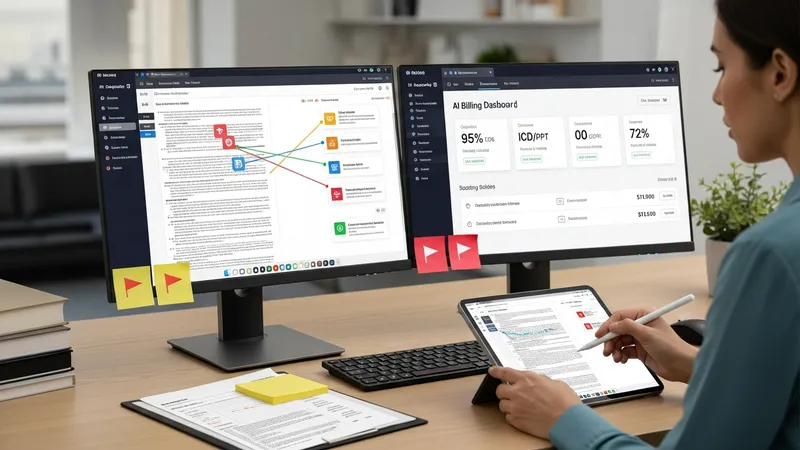
- Automated claims adjudication systems — software that uses rules and machine-learned patterns to check claims for completeness, consistency, and payer-specific requirements before submission.
- Natural language processing (NLP) for coding support — tools that analyze clinical notes to suggest diagnostic and procedure codes or to surface missing documentation that may be required for a claim.
- Analytics and reporting platforms for revenue cycle monitoring — dashboards and reporting tools that aggregate claim status, denial reasons, and payment posting trends to inform process adjustments.
One way to view automated claims processing is as a layered model: data capture (OCR, structured export), clinical-to-billing translation (NLP, mapping), claim validation (rules engine, payer rules), and performance feedback (analytics). Each layer may be provided by separate modules or an integrated platform. For example, capture technologies may convert scanned documents into text that an NLP model then annotates for relevant billing concepts. The validation layer typically applies payer rules and common-sense checks to reduce trivially rejectable submissions, while analytics measure throughput and recurring error types.
Rule-based engines and machine learning components often coexist in contemporary implementations. Rule-based logic can encode explicit payer requirements and deterministic checks that are easy to interpret, while machine-learned models may identify patterns of human error or complex associations in denial data that rules do not capture. In many settings, governance frameworks require that outputs from probabilistic models be explainable and subject to human review, especially where coding choices affect reimbursement or compliance. This hybrid approach may help organizations balance efficiency and auditability.
Denial management and error detection are common focus areas for automation. Automated systems can categorize denials by likely cause — missing authorization, coding mismatch, or eligibility issues — which may speed triage and appeal preparation. Payment posting automation may normalize remittance advice information and reconcile expected versus actual payments. However, practical deployment typically involves iterative tuning of models and exception-handling workflows so that automated classifications align with the organization’s documentation and billing policies.
Adoption of AI features in billing workflows often prompts closer attention to data quality and standardization. Performance of NLP and learning algorithms usually depends on consistent clinical documentation and accurate mapping between clinical concepts and billing terminologies. Organizations may therefore invest in documentation templates, staff training, or integration work to improve inputs. These measures frequently complement automation and may influence how much manual effort is reallocated versus eliminated.
In summary, AI medical billing encompasses a set of technologies that may automate portions of claims management, support coding decisions, and surface patterns in denials and payments. Implementations commonly layer data capture, NLP-based mapping, rule-based validation, and analytics, with human oversight retained for exceptions and compliance review. The next sections examine practical components and considerations in more detail.