
Coding Basics: Core Concepts Shared Across Popular Programming Languages

Programming at its foundation is a set of repeatable ideas that appear across many languages. These ideas include how a program stores values, how it decides what to do next, how it repeats work, and how it groups operations into named units. Describing these shared elements helps learners transfer knowledge from one language to another, because the same underlying concepts are implemented with different syntax and libraries rather than entirely distinct paradigms.
Core elements commonly addressed when learning to write code include representation of information, operations on that information, and the structures that control execution. Understanding these elements in abstract terms — for example, what a variable represents or how a function encapsulates work — can make it easier to read documentation, debug behavior, and compare language choices without relying on language-specific idioms.
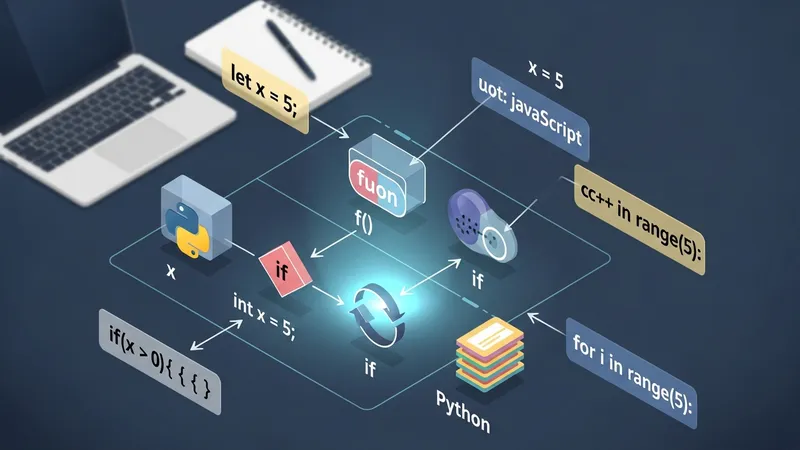
- Python — often used as an introductory language; emphasizes readable syntax and has dynamic typing and built-in data structures.
- JavaScript — commonly used for interactive web environments; typically event-driven and supports prototypal objects and first-class functions.
- Java — statically typed and frequently used in large systems; emphasizes explicit types, object-oriented patterns, and a defined runtime model.
Variables and data representation are central to most languages. A variable is a named reference to a value or storage location; implementations differ, with some languages associating a type with the variable itself and others associating type with the value. Primitive types like integers and booleans are usually handled directly by the runtime, while composite types such as arrays, lists, or objects may involve references and mutation semantics. Understanding whether an assignment copies a value or a reference can often clarify unexpected behavior when working across languages.
Operators and expressions provide the mechanisms for computing and combining values. Arithmetic, comparison, and logical operators are broadly similar, but precedence rules and short-circuit evaluation can vary. Some languages provide operator overloading or additional operators for sequence manipulation and membership tests. When translating algorithms between languages, it is useful to verify how equality and identity are defined to avoid subtle bugs in comparisons or collection membership checks.
Control flow constructs determine the order of execution. Conditional statements, loop constructs, and exception or error handling form a shared vocabulary that can be mapped across syntaxes. For example, a conditional branch and a switch-like construct are present in many languages, though their exact forms and pattern-matching capabilities differ. Looping often appears as for, while, or iterator-based constructs; many modern languages also provide higher-order iteration tools that abstract explicit loop management.
Functions, modularity, and scope describe how code is organized and how names are resolved. Functions may be first-class values, allowing them to be passed and returned, or they may be more constrained. Scope rules — block scope, function scope, or lexical closures — influence name visibility and lifetime. Debugging approaches such as using interactive REPLs, logging, and step-through debuggers are common across ecosystems and can be selected based on the runtime and tooling available for a language.
Problem-solving patterns such as decomposition, iterative refinement, and basic data-structure selection are portable across syntaxes. Simple algorithms like searching, sorting, and traversal are typically expressed using the same conceptual steps even when implementation details differ. Recognizing these transferable patterns helps learners adapt to new environments by focusing first on algorithmic logic and second on language-specific syntax or libraries.
In summary, the subject centers on transferable programming ideas: storage and types, expression and operators, control flow, and modular organization. These concepts are implemented in different ways across languages such as Python, JavaScript, and Java, and awareness of their commonalities can reduce friction when learning additional languages. The next sections examine practical components and considerations in more detail.