
Industrial Machines: Key Roles In Modern Manufacturing Processes

Modern manufacturing processes frequently depend on the integration of industrial machines to carry out a wide range of repetitive or precision-driven tasks. These machines may be designed for functions such as handling materials, performing assembly, and enabling accurate operations within production environments. Their utilization is observed widely across both large-scale factories and smaller production sites, reflecting their adaptability and role in enhancing efficiency while minimizing manual intervention.
In practice, industrial machines encompass both automated and semi-automated systems. Examples include robotics, conveyor belts, and computer-numerically-controlled (CNC) machine tools. The evolution of these technologies has led to refined capabilities, such as precise control over process variables and the ability to work continuously with minimal interruptions. While there is significant potential for enhanced productivity, outcomes can vary depending on the integration level, staff proficiency, and the complexity of manufacturing requirements.
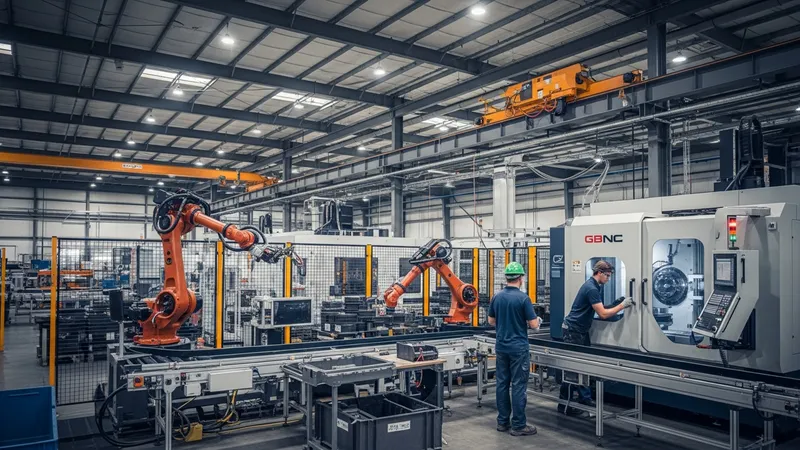
- Robotic Arms: Often used for assembly and welding tasks; capable of performing repetitive motions with programmable accuracy.
- Automated Conveyors: Facilitate the movement of materials and products along production lines, supporting regulated workflow and logistics.
- CNC Machines: Enable computer-controlled cutting, drilling, and shaping of materials for high precision in manufacturing components.
Robotic arms have become commonly referenced when discussing automation in manufacturing environments. These devices can undertake tasks that may be hazardous or require fine dexterity and can be programmed to repeatedly follow exact sequences. Their integration typically aims to coordinate alongside human workers, offering support in areas such as part handling or automated screwdriving tasks.
Automated conveyor systems play an important role in ensuring consistent material flow throughout the production process. By reducing the need for manual loading and unloading, these machines can help in maintaining a steady pace on the manufacturing floor. Their configuration is highly adaptable, with systems that may include straight belts, curved paths, or modular sections to fit specific workflow requirements.
CNC machines are widely used for their ability to provide accurate and repeatable movements when machining metal, composites, or plastics. They operate through digital instructions, which may lead to improved dimensional accuracy when compared to traditional manual machining. The speed and repeatability of CNC operations could contribute to higher yields in precision parts manufacturing.
Each type of industrial machine requires consideration of safety protocols, ongoing maintenance, and the training of operators. Many facilities develop protocols that include regular inspections, emergency stops, and personal protective equipment to align with local occupational safety guidelines. The selection and configuration of industrial machines are often based on production goals, cost considerations, and the degree of customization required for specific manufacturing tasks.
In summary, industrial machines serve as foundational elements in the transformation of raw materials into finished products. Their selective integration can often bring improvements in consistency and throughput. The next sections examine practical components and considerations in more detail.