
5G Network Management: Integrating Service Orchestration For End-to-End Automation

Automation workflows, tooling, and lifecycle management
Automation workflows define the sequence of tasks from service request through deployment and into steady-state operations. Common workflow stages include design-time validation, resource reservation, function instantiation, configuration, and post-deployment verification. In U.S. practice, toolchains often integrate CI/CD pipelines for network functions, enabling iterative updates and configuration management. These pipelines may use container registries, infrastructure-as-code tools, and orchestration APIs to manage deployments consistently across test, staging, and production environments.
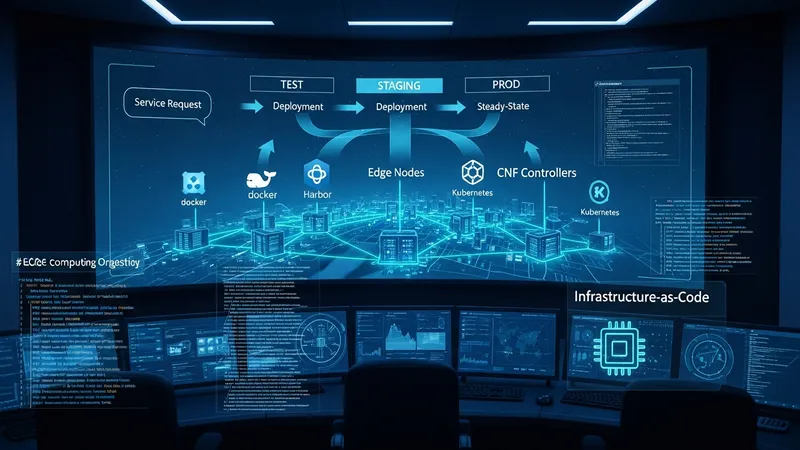
Tooling choices frequently blend open-source components with commercial platforms to meet scale and operational requirements. For example, Kubernetes distribution tailored for edge compute may be paired with network-specific controllers that handle CNF lifecycles. U.S. operators and systems integrators commonly use monitoring and logging stacks that support high-throughput telemetry and event correlation to feed automation triggers. Selecting tools that offer standard APIs and observable behaviors can simplify integration into broader operational processes.
Closed-loop automation patterns rely on assurance data to enact predefined remediation steps. In United States telemetry architectures, streaming platforms and time-series databases can provide near-real-time metrics that feed rule engines or ML-based classifiers. When anomalies are detected, workflows may initiate scaling actions, route adjustments, or configuration updates. Implementers typically design safeguards, such as rate limits and staged approvals, to prevent oscillation and unintended mass changes in production networks.
Lifecycle management often includes version control, rollback capability, and staged rollout strategies. U.S. deployments commonly adopt canary or progressive deployment methods to limit exposure during updates, with orchestration tooling coordinating traffic mirroring and gradual traffic shifts. Audit logs and change tracking are used to meet compliance and operational review needs, and these artifacts are frequently integrated into incident review processes so that automation-driven changes remain traceable and reviewable.