
5G Network Management: Integrating Service Orchestration For End-to-End Automation

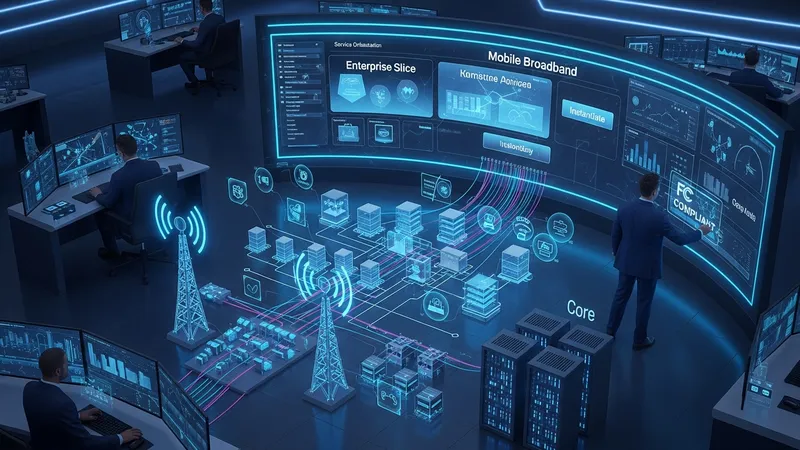
Modern cellular operations increasingly combine higher-level service coordination with automated control of underlying elements. In practical terms, this approach aligns service requests, such as a new enterprise slice or mobile broadband instance, with configuration actions across radio access, transport, and core domains. The model emphasizes translating service intent into workflows that allocate resources, instantiate virtual or containerized network functions, and apply policy rules so that the delivered capability matches the requested service parameters.
Implementation typically involves layered control: a service orchestration layer that understands offerings and service catalogs, and lower layers that handle resource orchestration and element configuration. End-to-end automation links the initial service lifecycle — from design and onboarding through deployment — to ongoing operational tasks such as monitoring, scaling, and healing. In United States deployments, operators and systems integrators often coordinate these layers to meet regional regulatory and operational expectations.
- ONAP (Open Network Automation Platform) — an open-source orchestration framework used in U.S. operator trials and deployments; it provides policy-driven orchestration and vendor-neutral adapters.
- Kubernetes-based CNF orchestration — container orchestration platforms adapted for network functions, often used in U.S. cloud and edge environments to manage lifecycle and scaling of containerized network services.
- ETSI MANO-inspired frameworks — management and orchestration concepts following ETSI NFV principles, commonly referenced by U.S. carriers for aligning VNFs/CNFs with operational OSS/BSS systems.
Service orchestration often operates with a service catalog or intent model that describes available offerings and their parameters. In U.S. contexts, catalogs may reflect regional service mixes such as fixed wireless access, enterprise private networks, and mobile broadband slices. The orchestration layer typically maps a catalog item to workflows that provision resources across multiple domains; those workflows can be templated and parameterized so that deployments repeat with predictable configurations. Integration with operational data sources assists in validating that deployments match intent.
Resource orchestration and element management follow the service mapping. Resource orchestration coordinates compute, storage, and transport allocation across cloud and edge sites, which in the United States frequently involves public cloud regions or carrier-operated edge nodes. Element management systems apply device-level configurations for radio units, transport gear, and core functions. These layers may use adapters and southbound plugins to translate generic orchestration commands into vendor-specific APIs or command sequences.
Monitoring and assurance feed back into orchestration through automated workflows. Telemetry streams, fault logs, and performance metrics may trigger policy-driven actions such as scaling a CNF or rerouting traffic. In U.S. commercial settings, operators often the integrate telemetry platforms that can handle high-volume streams and provide role-based access for operations and security teams. Closed-loop patterns that connect assurance outputs to orchestration inputs are typically implemented cautiously and tested to avoid unintended configuration churn.
Standards and interoperability play a central role in multi-vendor U.S. environments. ETSI NFV concepts, 3GPP slice definitions, and open-source projects contribute reference models that operators and vendors map to proprietary implementations. Where open interfaces are used, integration effort may reduce; however, many U.S. deployments also require adapters or translation layers to connect legacy OSS/BSS systems. Emphasis on modular, API-first designs may help manage heterogeneity during integration and operations.
Security, compliance, and operational policy are integrated into orchestration flows as constraints and validation steps. In the United States, operators often incorporate regional regulatory requirements and industry guidance when defining service parameters and data handling rules. Authentication and authorization mechanisms, secure transport for telemetry, and audit trails for lifecycle changes are commonly part of orchestration design to support governance and incident response processes.
Overall, combining service-level orchestration with automation can streamline lifecycle tasks from provisioning to assurance while accommodating the complexity of multi-domain networks. In U.S. practice, pilot projects and phased rollouts often determine appropriate automation scope before scaling. The next sections examine practical components and considerations in more detail.